Access to barriers, gates and doors for people and deliveries. It rests on our own GSM controller and ten years of practice: the ParkMyCar startup, the EPAM car parks and the TPS Gate service. The project is paused now. I am looking for people who want to take it further.
Built on
PMCN V6 controller, server logic
Where it ran
EPAM car parks from 2016, TPS Gate
Next version
V7 spec: LTE and voice over the internet
Market
Spain, then the EU
My role
Founder, architect, partnerships
As of 27.09.2026
Paused
In short
Since 2016 I have been building access systems for car parks and sites. The first big rollout was the EPAM car parks. Then came TPS Gate, a profitable access service for couriers in Russia.
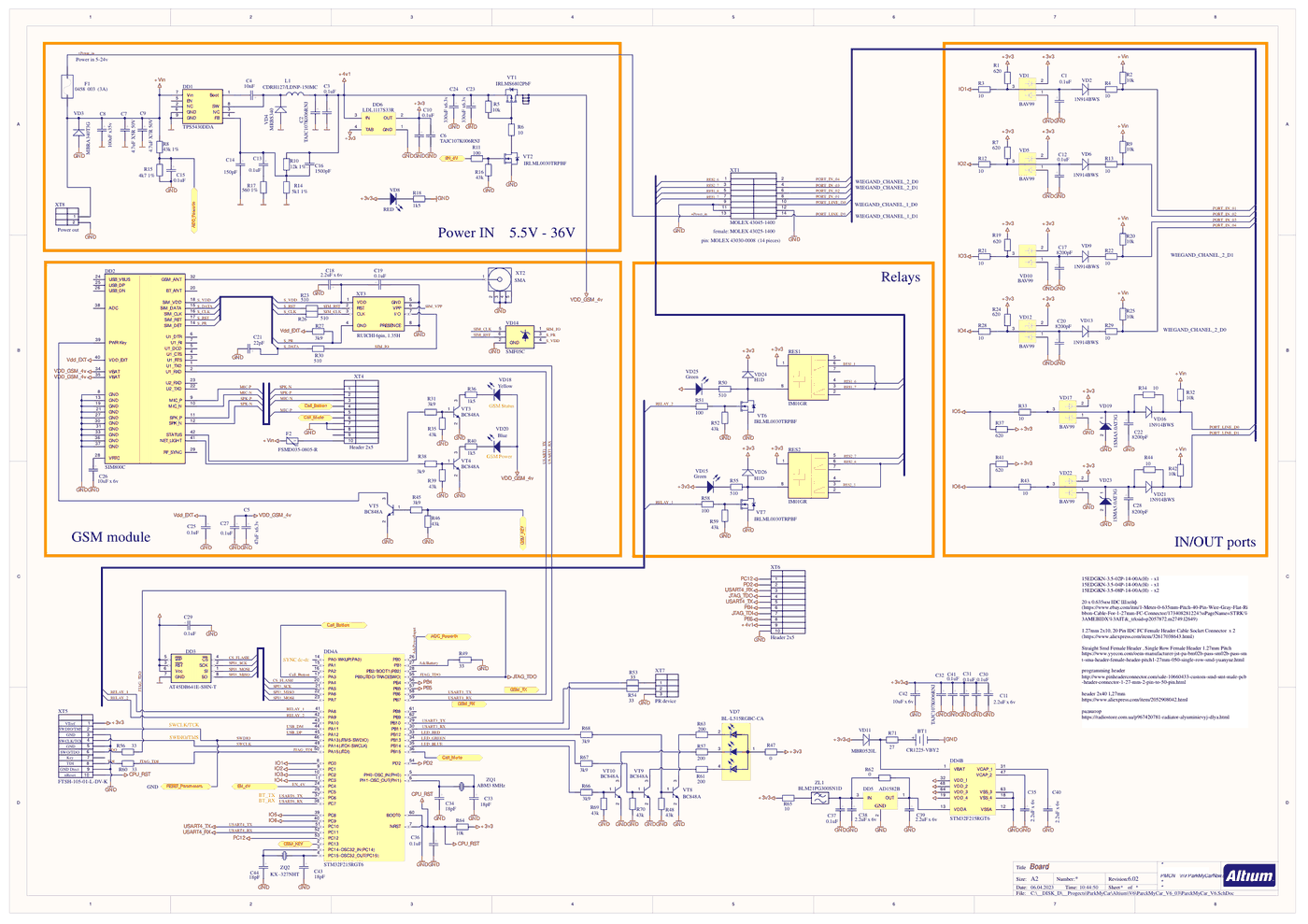
For these projects we developed our own controller. It opens a barrier by a phone call, a card, a number plate or a server command, and keeps working without the internet. I have published the schematic of its main board.
For Europe the controller needs an update. Its modem works only on 2G, and the manufacturer guaranteed the module’s production only until the end of 2022. Data protection has to meet EU rules. The spec for the new version is drafted.
After that come several directions: a network of connected garages, access for couriers, robots in residential buildings, sharing parking spaces, spaces for bicycles and motorbikes. None of them has been tested in Spain yet.
The project is paused. You can take it over and run it, buy the assets as a whole or in parts, or develop it together.
Not known yet: who in Spain will pay for access and how much; what a European company may use from the existing work, and on what terms.
How to read this pageThis is not an investment offer. It describes what was built and worked, what is on hand and what is still only a hypothesis. Terms of participation are discussed personally.
Where the facts come fromAbout past projects: my archives, meaning schematics, source code and documentation. About the Spanish market: open sources, with links at the bottom of the page.
Three projects in a row, one theme: access to a site.
Each stage grew out of the one before. The idea of sharing parking spaces led to an order to automate car parks. For that order we built our own controller. On the controller grew a service for couriers.
ParkMyCarMy startup, where it all beganThe idea: share parking spaces. A space that stands empty by day or by night can be used by another driver. The name ParkMyCar later went to the platform and the controller: PMC.
2016 · EPAM car parksThe first big rollout · Minsk · the contract and the launch were on meA contract to automate the car parks at EPAM’s offices. From signing to the first working site took three and a half months. In that time we built our own board and 15 controllers, the firmware, the server, the import of employees from EPAM’s system and a web app for employees. A little later came LED displays showing free spaces. About six car parks in all; the system ran for many years.
2018-2019 · second iterationPaid parkingSubscriptions with a quota of spaces, a 10-minute booking, free space counting, number plate recognition, online payment. The hourly price depended on how full the car park was. The devices learned to update their firmware over the air and to send telemetry.
2020 · without the internetA test of the architectureDuring the protests in Minsk mobile internet was switched off. The barriers kept opening by phone call: the controller needs neither the internet nor the server for that. More in “Working without the internet”.
TPS GateFounder: product, operations, fundraising · RussiaA courier delivery automation service: couriers get access to sites, barriers and car parks. The service works and is profitable. For it, in 2021-2023, we built the V6 controller with MQTT. Inside TPS Gate we also tried a service for residential complexes: reassigning spaces, selling your own space, issuing virtual passes to guests.
2026 · TPS Gate EuropeSpainI live in Valencia and checked what of this experience can move to Spain. I went through the archives of the hardware, the firmware and the server, wrote a spec for the new controller version and studied the market. That is where the project stopped. Why, see “Where the project stands”.
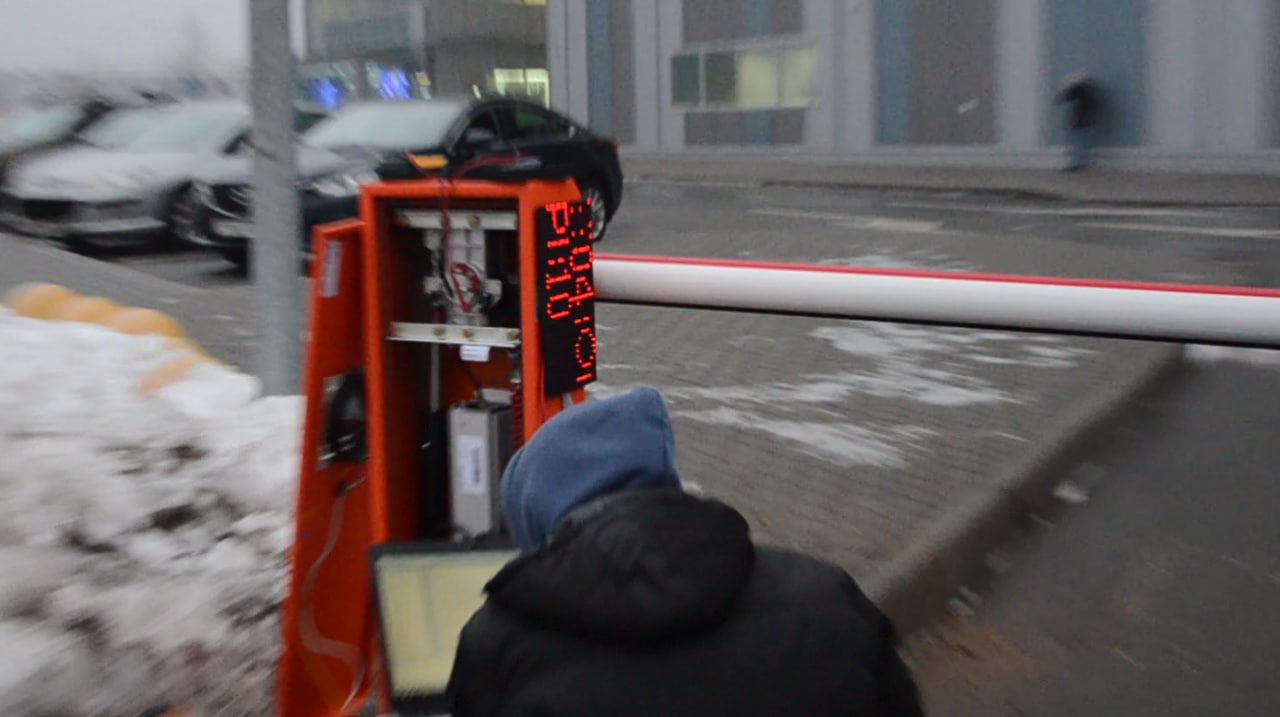
Working at an open barrier cabinet with a display. A frame from a video.
The PMCN controller
What it can do and what it is made of. The latest board revision is V6.03, April 2023.
PMCN is a controller for a barrier, gate or door with its own GSM modem. The main thing about it: it decides “let in or not” on its own, from its own list. The server is there for management, logs and updates, but traffic does not stop without it.
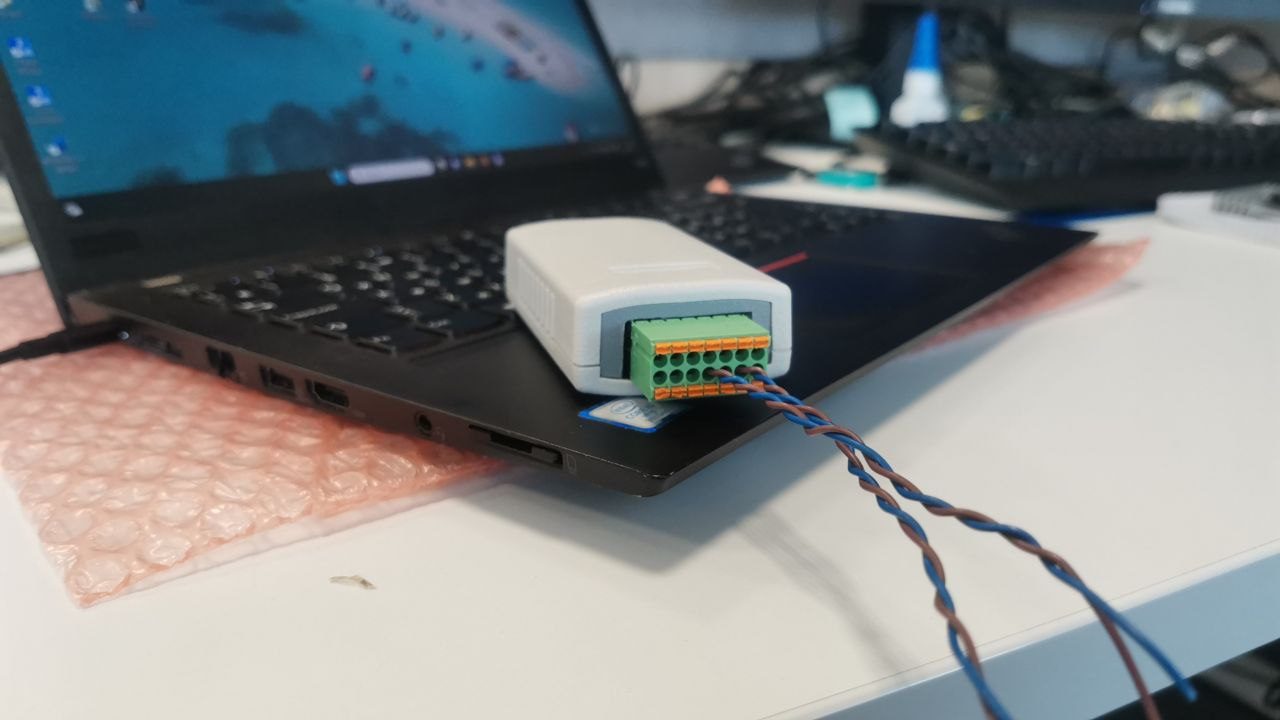
The V6 controller in its enclosure, 2023.
The diagram scrolls sideways.
Blocks of the V6.03 board. The full schematic and the board layers are further down the page.
How it opens
By phone call. The driver calls the controller’s number. The controller recognises the number and opens if it is on the list. No internet needed.
By card or fob. Two Wiegand readers; the code length is detected automatically.
By number plate. A recognition camera connects over UART. The plate is looked up in the same list as phones and cards.
By server command: open and close, hold open, close. Taking direction into account: entry or exit.
By button, an external input or in free passage mode.
By the operator during a call, with a tone command from the phone.
By asking the server, if a phone or card is not in its own list.
What it remembers
Its own list. Phones, cards and number plates are stored in one format, and the search runs right in flash memory. A new list is loaded next to the old one and switched on in one step, so an update does not interrupt work.
A log of passages: who opened and how, the direction, sensor triggers.
Error and event logs. They live in battery-backed memory and survive a power cut.
How it runs unattended
A link watchdog. If the modem goes silent, the controller cuts its power and restarts it. It never touches the modem during a call. This circuit appeared after modem hangs at the first site.
Without the server. The decision is made from its own list; the log goes to the server when there is a connection.
Firmware updates over the air. The bootloader checks the image’s integrity before installing it.
Remote configuration and telemetry.
What else connects
Loops and photocells. They tell the controller that a vehicle passed and in which direction.
LED displays on panels with a 16-pin connector: free spaces and any text.
An audio panel so the driver can talk to the operator.
An expansion connector with UART for your own modules.
V6.03 hardware
Processor
STM32F215: ARM Cortex-M3, 120 MHz
Connectivity
SIMCom SIM800C module, 2G: calls, SMS, GPRS. SMA antenna
Memory
DataFlash 16 Mbit, FRAM 1 Mbit, battery-backed memory and clock
Outputs
2 relays
Inputs
4 digital inputs, 2 Wiegand channels
Terminals
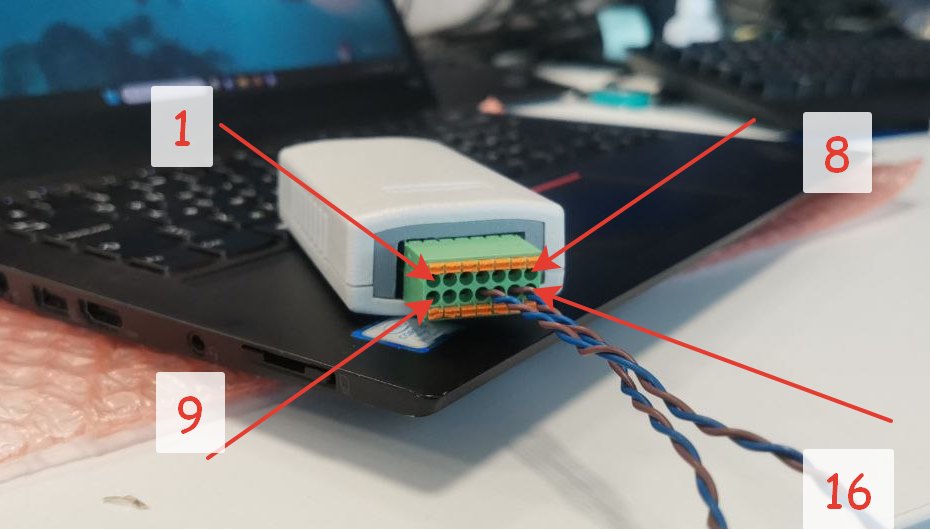
16 spring terminals, two rows of 8
Interfaces
UART for a plate camera, audio panel, LED display, expansion connector
Board
82.2 × 37.5 mm, two layers. A standard off-the-shelf enclosure
Firmware
C, no operating system. A bootloader with over-the-air updates. MQTT since 2021
Revisions
V6: December 2021, V6.02: January 2022, V6.03: April 2023
Production
Small batches. The latest parts costing is for 30 boards
Photos and 3D models
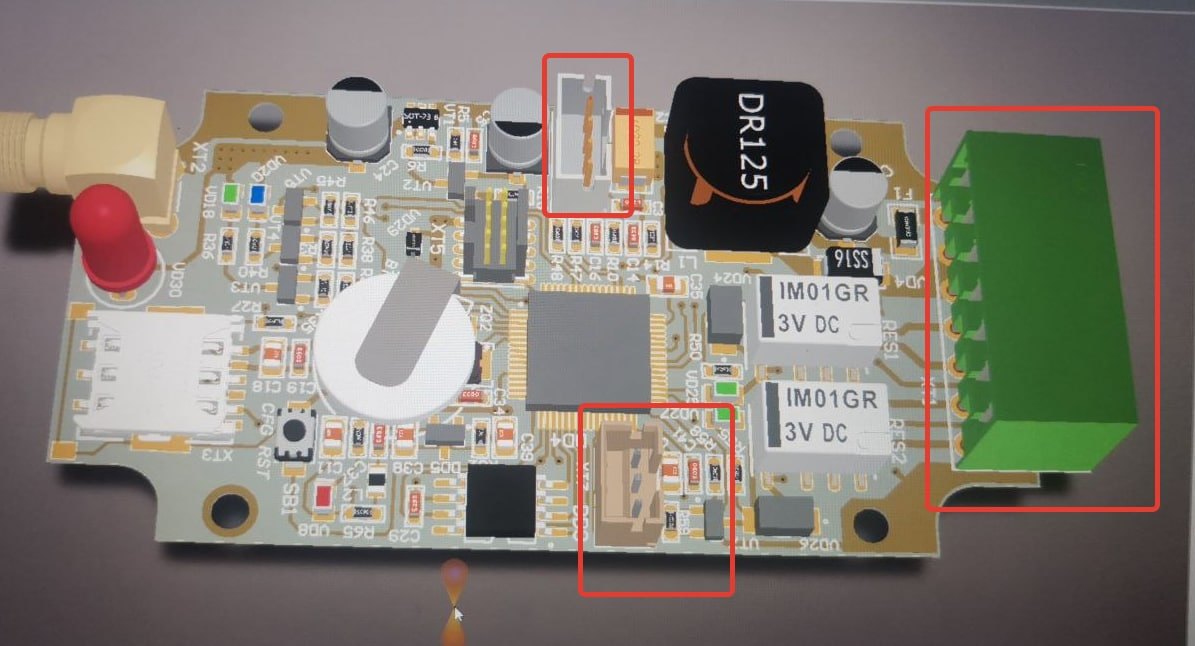
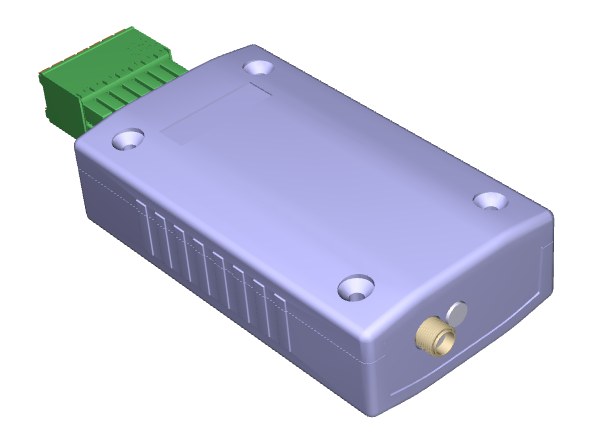
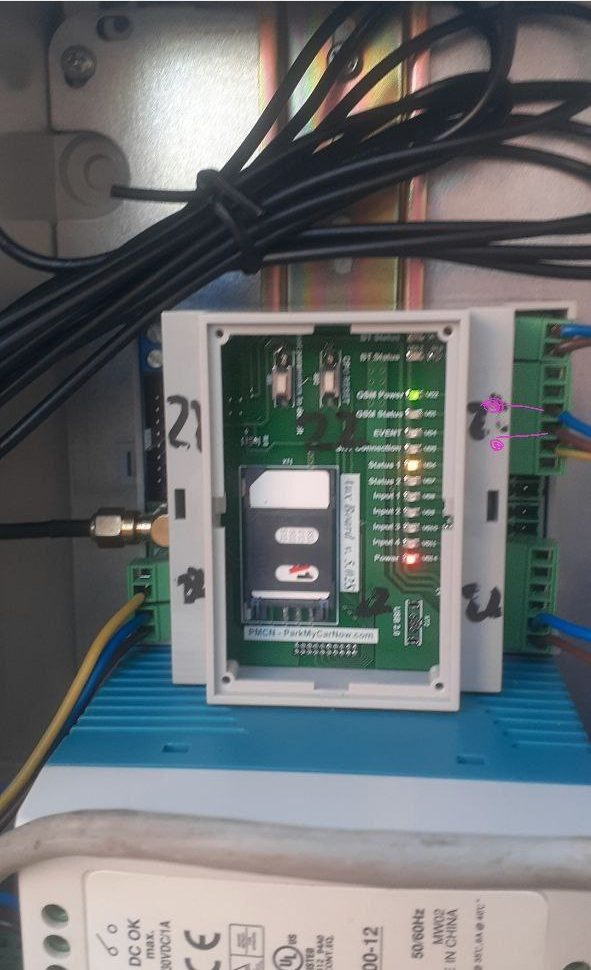
A 3D model of the V6 board: SIM holder, clock battery, processor, two IM01GR relays, terminal block. A screenshot.A 3D model from the board documentation: the terminal block on one side, the SMA antenna on the other.Terminal numbering: top row 1-8, bottom row 9-16.A PMCN controller in a cabinet on site, 2021: the enclosure on a DIN rail, with the power supply below.
The board schematic, open to everyone
I am publishing the documentation of the V6.03 main board. If it is useful to you, download it and use it. As is.
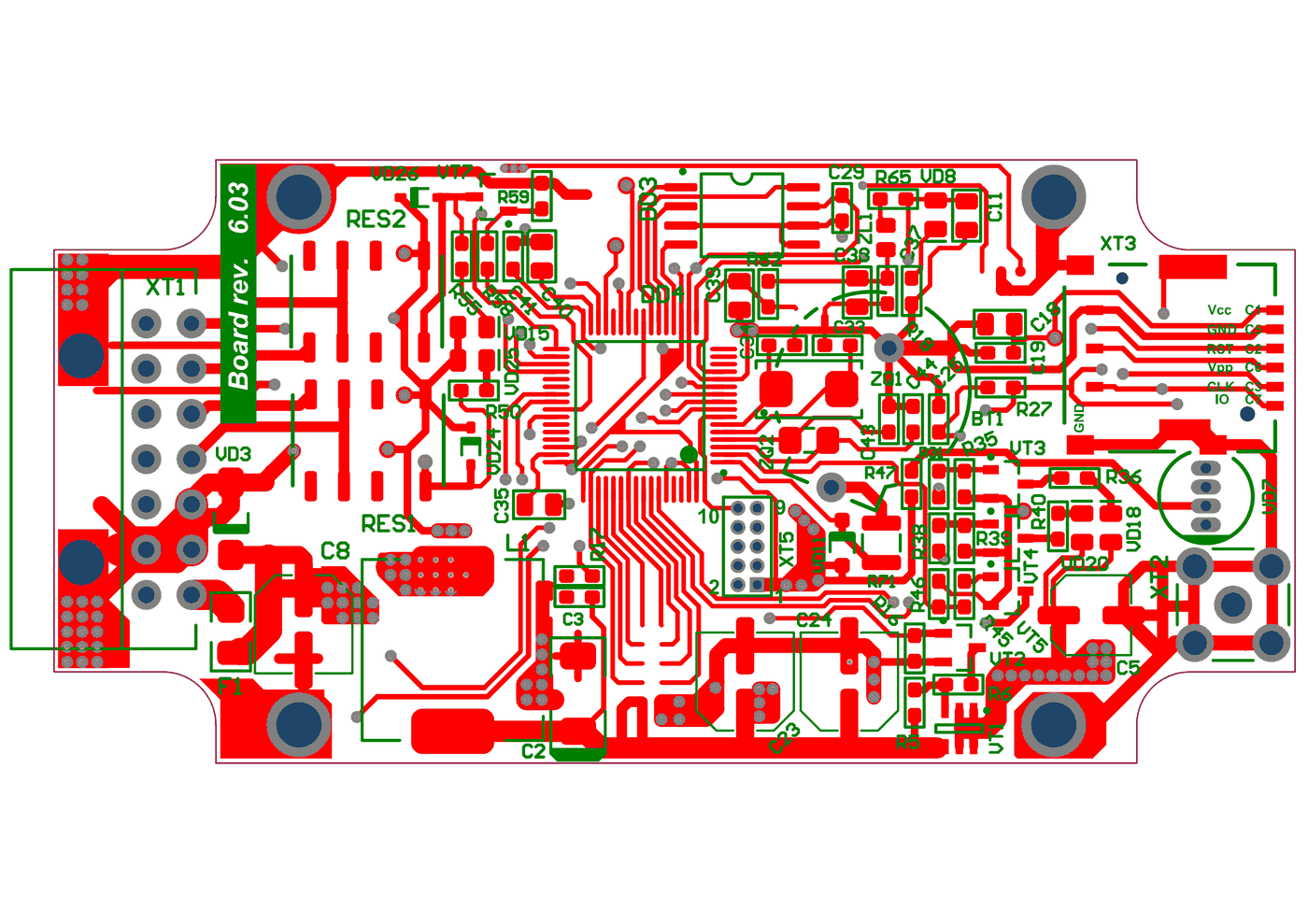
The V6.03 schematic.The top layer of the board.
File
PDF, 8 pages, 7.4 MB
Inside
Schematic, board layers, assembly drawings, dimensions, bill of materials, 3D model
The 3D model inside the PDF opens in Adobe Acrobat. You can enlarge the schematic and the board layer: click the picture, then click again to see it at full size.
Working without the internet
The main engineering decision of 2016.
What has to keep working when everything else is down? We answered that question in 2016, and the answer shaped the whole system.
At the first site the main risk was connectivity. GSM modems hung, mobile internet dropped out, and a server can fail too. But a barrier has to open every time: a person is sitting in a car in front of it, and they do not care what broke on our side.
So every part of the system worked on its own. The controller kept the list of employees and opened on a call without the server. The free space displays had their own controller and their own SIM card. Number plate recognition was a separate device. Any part could go offline, and opening by phone call kept working.
In 2020 real life tested it. In Minsk mobile internet was switched off, and the barriers kept opening by phone call. We designed it that way because of hanging modems, and it turned out useful in a completely different situation.
The diagram scrolls sideways.
The 2016 system. The highlighted path depends neither on the internet nor on the server.
In V7, opening by call moves to the cloud: the driver calls the service’s number, and the command goes over the data channel. Cards, the button and its own list still work without a connection, but opening by call without the internet will no longer be possible. This decision has to be made again for the new version.
Server and protocol
What is already written on the server side.
The ParkMyCar platform was written from 2016 to 2020. Besides opening a barrier, its code has:
access by group and the import of employees from the client’s corporate system;
a visit log and real-time occupancy, free space counting, including by camera;
tariffs and subscriptions: a quota and ranges of spaces, a 10-minute booking;
an hourly price that depends on how full the car park is;
number plate recognition, over-the-air firmware updates, device telemetry;
opening by SIP call and by GSM relay over SMS where our controller is not installed;
online payment and a white-label mode under the TPS brand.
The controller and the server talk over their own protocol with about 20 commands: time and status, opening, logs, loading the list in batches, checking a call, card or plate with the server, settings, text on the display, firmware updates. Since 2021 the protocol runs over MQTT. There is a separate spec for integration with TPS Gate barriers, January 2023.
For Europe this code is a knowledge base. It cannot be run as is: it needs a clean-up and a security review, and the protocol needs a new version with encryption and message authentication.
Paused
Where the project stands
Status as of 27 September 2026.
What was done in 2026
The archives were gone through: the V6.03 board, the firmware source, the 2016-2020 server platform, the MQTT integration spec.
A spec for the V7 controller was written, draft 0.1.
The Spanish market was studied: gate openers, courier access, parcel lockers, delivery robots, lifts.
V6 and V7
V6.03, exists
V7, in the spec
Connectivity
2G, SIM800C. Production of the module was guaranteed only until the end of 2022
LTE Cat-1bis
Voice
GSM
Over the internet: SIP over TLS, audio over SRTP
Opening by call
A call to the controller’s SIM, works without the internet
A call to a cloud number (+34), the command over the data channel
Configuration
Server, SMS
Server, USB-C, a 128 × 64 screen and two buttons
Readers
2 × Wiegand
2 × Wiegand and OSDP over RS-485
LED displays
Driven directly by the board
A paid expansion module over RS-485
Offline
Its own list and log
A list of at least 10,000 cards and plates, a buffer of at least 10,000 events
Security
Firmware integrity check
Secure boot, signed updates with rollback, hardware key storage
Enclosure
A standard off-the-shelf one
The same enclosure and board size
V7 exists only as a spec. Development has not started.
What it takes to move on
Choose one direction and test it in conversations with those who will pay.
Develop and certify V7. In the EU that means CE marking under the Radio Equipment Directive (RED), including the EN 18031 cybersecurity requirements, and from December 2027 the Cyber Resilience Act in full.
Build a new server side: protocol v2, encryption, data in the EU.
Check the rights: what a European company may use from the existing work, and on what terms.
Find a person or a team who will run the project every day.
Why it is paused
The project has reached the point where it needs money for V7, a choice of direction and a team. I can be the founder, architect and partner, but I do not want to install and service devices myself. Until there is a partner who takes over the operations, I am not moving the project.
Directions
Five directions. All are hypotheses so far; none has been tested in Spain.
For each direction: what speaks for it, what speaks against it, and which check I would start with. A check means conversations with those who will pay. I do not start development before it.
A network of connected garages and entrances
Hypothesis · the base for the others
Sell V7 to installers and owners’ associations for garages and entrances. Every device is connected to one system, and together they form a network of access points that can later be opened to deliveries.
For
Associations in Spain already pay to open a garage from a phone. V7 can do more than a simple GSM relay: its own list, a log, voice with an operator, work without a connection.
Against
The market is crowded. GSM modules that open on a call are sold in shops for installers. Apps like PuertApp connect to the remote the association already has, with no work on the motor.
First check
5-8 conversations with installers in Valencia: would they install V7, at what price, and what stops them now.
Access for couriers
Hypothesis · closest to the TPS Gate experience
The TPS Gate model in Spain: a courier gets temporary access to a site, a car park and an entrance, and the sites are joined into one network.
For
This continues a working service rather than a new idea. Every failed delivery costs the carrier money.
Against
Amazon is building its own access. Amazon Key has worked in Spain since 2022 for associations of 30 or more neighbours, and since September 2025 it has an exclusive alliance with Intratone. The other carriers install parcel lockers: Citibox has more than 60,000 lockers in Madrid, Barcelona and London, and Correos installs Citypaq in residential buildings for free. I could not find in open data how many buildings in Spain let couriers in.
First check
5-8 conversations with last-mile managers: Paack, SEUR, GLS, CTT Express, Correos Express, Glovo. What a failed delivery costs them and whether they would pay for access to a building.
Robots: car park, lift, door
Hypothesis · a distant horizon
The same access layer for delivery robots: entry through the car park, the lift, the building door.
For
Spain has more than a million lifts, the most per person in the world, and 65% of people live in apartment buildings. Otis, KONE, Schindler and TK Elevator already offer interfaces for robots.
Against
The Goggo Network delivery robot pilot in Zaragoza was wound up in November 2023 because of the company’s financial problems. Robot interfaces exist only on lifts with controllers from roughly the last ten years, and an old lift without a service company is out of reach.
First check
2-3 conversations with robot operators and lift companies: who would pay for what right now.
Sharing parking spaces in residential complexes
Hypothesis · the logic is already written
Residents rent out and sell their spaces, issue virtual passes to guests, and the management company sees occupancy. This is the original ParkMyCar idea and an attempt inside TPS Gate.
For
The logic already worked: subscriptions, quotas, booking, prices based on occupancy, passes.
Against
The main objection is security: strangers in the garage of a residential building. Add insurance and a decision of the owners’ general meeting.
First check
5 conversations with residential property administrators (administradores de fincas): would the association allow it, and on what terms.
Spaces for bicycles and motorbikes
Hypothesis · more a feature than a business
Spaces for bicycles and scooters are marked out in the building’s garage, for example space C12 with an anchor for a lock. A motorbike takes two such spaces. A space can be assigned to a resident, rented to a neighbour or made a rental point.
For
The Ministry of Housing is preparing a change to the building code (CTE): in new buildings, two spaces for a bicycle or scooter per flat, at least 2 m² each. Bicycles in shared garages already cause disputes and insurance questions. I have rental experience: I implemented a management system in an e-bike rental company.
Against
The rule is still a draft and covers only new buildings. Few people are ready to pay for such a space. It is more a feature for a developer or an association than a business of its own.
First check
3-5 conversations with developers (promotoras) and administrators: do they need managed bike parking, and who pays for it.
What I would choose
Closest to my experience is access for couriers. I would go in through garages: associations already pay to open a garage from a phone, and every connected garage becomes a future delivery point. The final choice depends on the check and on who will run the project.
What is on hand
What can be handed over or used in a new team.
What
In what form
State
V6.03 schematic and board
The Altium project, Gerber files, a costed bill of materials for a batch of 30 boards. A PDF with the schematic, layers and 3D model is open on this page
Latest revision: 6 April 2023
V6 firmware and bootloader
C source code, IAR environment
Used on TPS Gate sites. Needs a review before V7: in the latest branch some call functions are disabled
Exchange protocol
About 20 commands, described in the code. The MQTT integration spec, January 2023
The EU needs version 2 with protection
ParkMyCar server platform
PHP source code, 2016-2020
A knowledge base; not fit to run as is
V7 spec
Draft 0.1, September 2026
Ready to discuss with a developer
Spanish market analysis
Directions, competitors, EU rules
September 2026
Photos and 3D models
An archive of site photos and board renders
Some are on this page
Experience
A launch in three and a half months, operations, integrations with other systems, fundraising
Since 2016
RightsWhat of this a European company may use, and on what terms, I am checking separately: rights to the code and schematics, the legal entity, the data. It is part of the conversation with everyone who wants to take something.
How to take part
Terms, timing and money are discussed in conversation.
Take the project and run it
You are an operator or co-founder in Spain: pilot, sales, installation, support. I stay the founder, architect and partner: product, connections, key decisions.
Buy the assets
As a whole or in parts: hardware, firmware, protocol, server logic, spec, market analysis. A fit for those who already have their own product in access, parking or delivery.
Develop it together
A manufacturer or integrator of access systems, a delivery or robotics company, a developer, a management company. You can start with one pilot site.
Work on the project
Embedded systems (STM32, LTE, VoIP), backend, installation and sales in Spain. Once the project comes off pause.
Stories
I will tell them separately.
“Three and a half months”From the EPAM contract to the first working site.
In preparation
“What has to work when everything else is down”Why the system survived the internet shutdown.
In preparation
How we took the market with TPS Gate
Later
How we brought vendors on board
Later
Start a conversation
I reply personally.
Write what caught your interest and which role you see yourself in: operator, partner, buyer of the assets, pilot site or engineer.
Saved. I have your message.
I will reply personally, usually with a couple of questions about how you see your part. Terms are discussed in the conversation, not in the form.